Eight ube powder recipes for home and café: ube latte, pancakes, cake, chocolate, ice cream and cheesecake, with grams, timings and café notes.
What can you make with ube powder?
Ube (purple yam, Dioscorea alata) is the purple root vegetable of Filipino cooking. It tastes somewhere between vanilla and hazelnut, with a faint earthy note behind it, and its colour comes from anthocyanin pigments. Working with the powder rather than the fresh root is a practical choice: the powder keeps far longer, its colour and flavour intensity are more consistent batch to batch, and because it is dosed in grams you can cost a portion.
The ube in this article is the culinary purple yam root. It has nothing to do with UBE, the abbreviation for unilateral biportal endoscopy in spinal surgery.
The eight recipes below use quantities adapted by our kitchen team, and each one gives a yield, a prep time, a gram-weighted ingredient list and a café note. What ube powder actually is, how pure powder differs from a sweetened instant drink mix, and what to confirm before you buy are covered in our guide to ube powder; for packaging and specification, see the Ube Powder product page.
How to use ube powder: 5 basic rules
Before the recipes, the five rules every formula below rests on:
- Bloom the powder first. Never tip ube powder straight into hot milk or a dry mix. For 10 g of powder, work in about 20 ml of hot water, warm milk or melted butter to a smooth paste and let it sit 2-3 minutes until the colour deepens. In starch-set puddings, make the paste with cold milk.
- Tie the dose to the portion. The drinks here use 6-10 g per serving; the baked recipes use 14-21% of the flour weight. Chilled desserts need only 1-3 g per portion.
- Keep the water low. Blooming with more liquid than needed fades the colour. Anthocyanin pigments are also pH sensitive: acid pulls the purple towards pink, alkali towards blue and grey. Test small before you add lemon or bicarbonate.
- Sugar and fat carry the flavour. Ube's vanilla-hazelnut note sharpens in a rich, sweet base; white chocolate, butter, cream and condensed milk lift both the colour and the taste.
- Do not mix pure powder with an instant latte blend. Pure ube powder leaves the sweetness to you and gives full control over a formula; a sweetened drink mix speeds up the bar but limits how you balance sweetness in pastry. Every gram figure in this article is for pure ube powder.
What Is Ube Latte and How Do You Make It? Hot and Iced Recipe
Ube latte is a purple coffee drink made by loosening ube powder with a little hot water and combining it with espresso and milk. It tastes vanilla-like and lightly sweet; leave out the espresso for a caffeine-free ube milk. One serving needs 8 to 10 grams of ube powder. The hot and iced measurements follow.
The ube latte is the fastest way onto a menu: an espresso machine and a whisk are all the equipment you need. The iced version is the summer signature and the hot one is its winter counterpart.
Hot Ube Latte

1 serving · 4 minutes · 10 g ube powder per serving
Ingredients
- 10 g ube powder
- 20 ml hot water (to bloom the powder)
- 180 ml milk
- 60 ml espresso (2 shots)
Method
- Work the ube powder into a smooth paste with the hot water.
- Spoon the ube paste into the bottom of the cup.
- Add the espresso and stir.
- Steam the milk to a foam.
- Pour the foamed milk slowly into the cup.
- Dust with a little ube powder and serve.
Café note: at 10 g per serving, 1 kg of ube powder is roughly 100 cups. Latte art works on the milk foam; position it on the winter menu as the counterpart to the iced version.
Iced Ube Latte

1 serving · 5 minutes · 10 g ube powder per serving
Ingredients
- 10 g ube powder
- 20 ml hot water (to bloom the powder)
- 180 ml milk (of choice)
- 60 ml espresso (2 shots)
- 1 glass of ice
- 10 ml syrup or sugar (optional)
Method
- Work the ube powder into a lump-free paste with a little hot water.
- Spoon the ube paste into the bottom of the glass.
- Fill the glass with ice.
- Add cold milk and stir until it combines with the paste.
- Pour the two espresso shots slowly over the ice so the layers form.
- Add syrup if you want it and stir lightly.
- Serve.
Café note: bloom the powder in as little water as possible to keep the colour vivid; too much water fades it. Coconut milk instead of dairy gives a plant-based version. Again 1 kg of powder is about 100 cups; blooming the powder into a syrup base ahead of service cuts the ticket time in peak hours.
Ube Pancake Recipe

Ube pancakes are the easiest purple item on a breakfast or brunch service. Buttermilk keeps the pancakes soft, and blooming the ube powder in melted butter is what releases the colour.
12 pancakes · 25 minutes · about 5 g ube powder per serving
Ingredients
- 360 g flour
- 2 tbsp brown sugar
- 3 tsp baking powder
- 1 tsp salt
- 480 g buttermilk (cultured)
- 120 g milk
- 3 eggs
- 57 g ube powder
- 55 g melted butter
- oil for the pan, as needed
Method
- Mix the flour, brown sugar, baking powder and salt in a large bowl.
- Bloom the ube powder in the melted butter and rest it 2-3 minutes until the colour deepens.
- Whisk the buttermilk, milk, eggs and the bloomed ube mixture until smooth.
- Pour the wet mix into the dry mix and stir briefly; the batter should stay lumpy.
- Heat the pan over medium heat and oil it lightly.
- Pour about 150 ml of batter per pancake and flip once bubbles form on the surface.
- Cook 2-3 minutes until both sides are golden.
- Serve hot with butter, maple syrup or ube cream.
Café note: 57 g of powder yields 12 pancakes, so 1 kg of ube powder is around 210 pancakes. Do not overmix; a lumpy batter gives a softer pancake. Cooked pancakes keep one month in the freezer and reheat in a toaster, and the same batter makes ube waffles in a waffle iron.
Ube Cake: Ube Pound Cake

A buttery pound cake is the most practical way to start selling ube by the slice from a display case.
1 loaf (10 slices) · 90 minutes including baking · about 2 g ube powder per slice
Ingredients
- 150 g flour
- ½ tsp baking powder
- ¼ tsp salt
- 227 g unsalted butter
- 200 g caster sugar
- 4 eggs
- 120 g sour cream
- 1 tbsp vanilla extract
- 21 g ube powder
- 60 ml warm milk (for the ube powder)
Method
- Heat the oven to 175°C and grease a 23x13 cm loaf tin.
- Combine the flour, baking powder and salt and set aside.
- Bloom the ube powder in the warm milk, then stir it into the sour cream and vanilla.
- Beat the butter until fluffy, add the sugar and keep beating until pale.
- Add the eggs one at a time, mixing well after each.
- Fold in the ube and sour cream mixture.
- Add the dry mix and stir only until combined, then pour into the tin.
- Bake 65-70 minutes until a skewer comes out clean; rest 10 minutes in the tin before turning out.
Bakery note: 21 g of powder makes one loaf, so 1 kg of ube powder is roughly 47 loaves or 470 slices. Score the centre of the batter with a wet knife and the cake opens along a clean crack. It keeps 3 days at room temperature, or a week wrapped tightly in the fridge. For a showier display piece, the same flavour works in a three-layer ube cake with Swiss meringue buttercream.
Ube Chocolate: Hot Chocolate and Coconut Truffles
Ube and white chocolate complement each other: the milk fat in white chocolate carries the flavour and pulls the colour towards a more vivid purple. Two applications, one drink and one confection:
Ube Hot Chocolate

1 serving · 6 minutes · 10 g ube powder per serving
Ingredients
- 200 ml milk
- 30 g white chocolate (melted)
- 10 g ube powder
- 20 ml hot water (to bloom the powder)
- 20 g whipped cream (to top)
Method
- Work the ube powder into a smooth paste with the hot water.
- Heat the milk and melt the white chocolate into it.
- Add the ube paste and whisk.
- Pour into the cup.
- Top with whipped cream and serve.
Café note: 1 kg of ube powder is about 100 cups. It also works with sweetened milk and no white chocolate, but white chocolate turns the colour a noticeably more vivid purple. A good evening-menu option for guests who do not drink coffee.
Ube Coconut Truffles

24 pieces · 30 minutes plus overnight setting · about 0.8 g ube powder per piece
Ingredients
- 380 g condensed milk
- 20 g ube powder
- 310 g white chocolate chips
- 200 g marshmallow cream
- 5 ml vanilla extract
- 130 g sweetened desiccated coconut for the filling, plus 300 g for the coating
Method
- Mix the ube powder with a little of the condensed milk to a paste.
- Heat the rest of the condensed milk with the white chocolate in the microwave for 1 minute and stir.
- Add the ube paste, the marshmallow cream and the vanilla and microwave 1 more minute.
- Stir in the coconut set aside for the filling.
- Pour the mixture into a lined square tin and level it.
- Chill at least 6 hours, preferably overnight.
- Divide the mixture into equal pieces and roll into balls.
- Roll the balls in the remaining coconut or in icing sugar and keep chilled.
Chocolatier note: 20 g of powder makes 24 truffles, so 1 kg of ube powder is around 1,200 pieces. Always sieve the powder and hydrate it before it meets a fat-based system, or it will clump. The deep purple centre contrasts with the white coconut coating. They keep a week refrigerated and sell well as an impulse buy in the small-sweets case by the till.
No-Churn Ube Ice Cream

This is the easiest entry point for a café with no ice cream machine: a condensed milk and whipped cream base gives a creamy texture without churning.
6 servings · 20 minutes plus overnight freezing · 3 g ube powder per serving
Ingredients
- 400 g condensed milk
- 18 g ube powder
- 40 ml warm water
- 5 ml vanilla extract
- 480 ml heavy cream (cold)
Method
- Mix the ube powder with the warm water to a smooth paste.
- Stir the condensed milk, ube paste and vanilla together in a large bowl.
- Whip the cold cream to soft peaks in a separate bowl.
- Fold a little of the whipped cream into the ube mixture to lighten it.
- Fold the lightened mixture gently into the remaining whipped cream.
- Transfer to a freezer-safe container and level the surface.
- Cover tightly with cling film.
- Freeze at least 8 hours, preferably overnight.
Ice cream note: 18 g of powder makes 6 servings, so 1 kg of ube powder is roughly 330 servings. The colour settles into a bright lilac-purple and the texture stays soft and creamy; it keeps 3 months in the freezer.
No-Bake Ube Cheesecake

With no oven required, this is the easiest ube dessert for a small café with limited equipment, and for a home kitchen. The coconut biscuit base suits ube well.
8 slices · 40 minutes plus overnight setting · about 2.5 g ube powder per slice
Ingredients
- 180 g graham crackers or digestive biscuits
- 25 g desiccated coconut
- 80 g melted butter
- 500 g cream cheese
- 20 g ube powder
- 40 ml warm water
- 165 g icing sugar
- 275 ml heavy cream (cold)
Method
- Blitz the biscuits to crumbs and mix with the melted butter and coconut.
- Press the mixture into the tin and freeze 10 minutes.
- Bloom the ube powder in the warm water to a smooth paste.
- Beat the cream cheese with the ube paste, then add the sifted icing sugar.
- Whip the cold cream to soft peaks in a separate bowl.
- Fold the whipped cream gently into the ube mixture.
- Spread the mixture over the chilled base and cover with cling film.
- Chill at least 3 hours, preferably overnight, then unmould.
Café note: 20 g of powder makes 8 slices, so 1 kg of ube powder is about 400 slices. The pale lilac colour and silky texture stand out in a display case; it keeps 4-5 days refrigerated or a month frozen. A kitchen with an oven can serve the same flavour as a burnt-top, molten-centre ube Basque cheesecake.
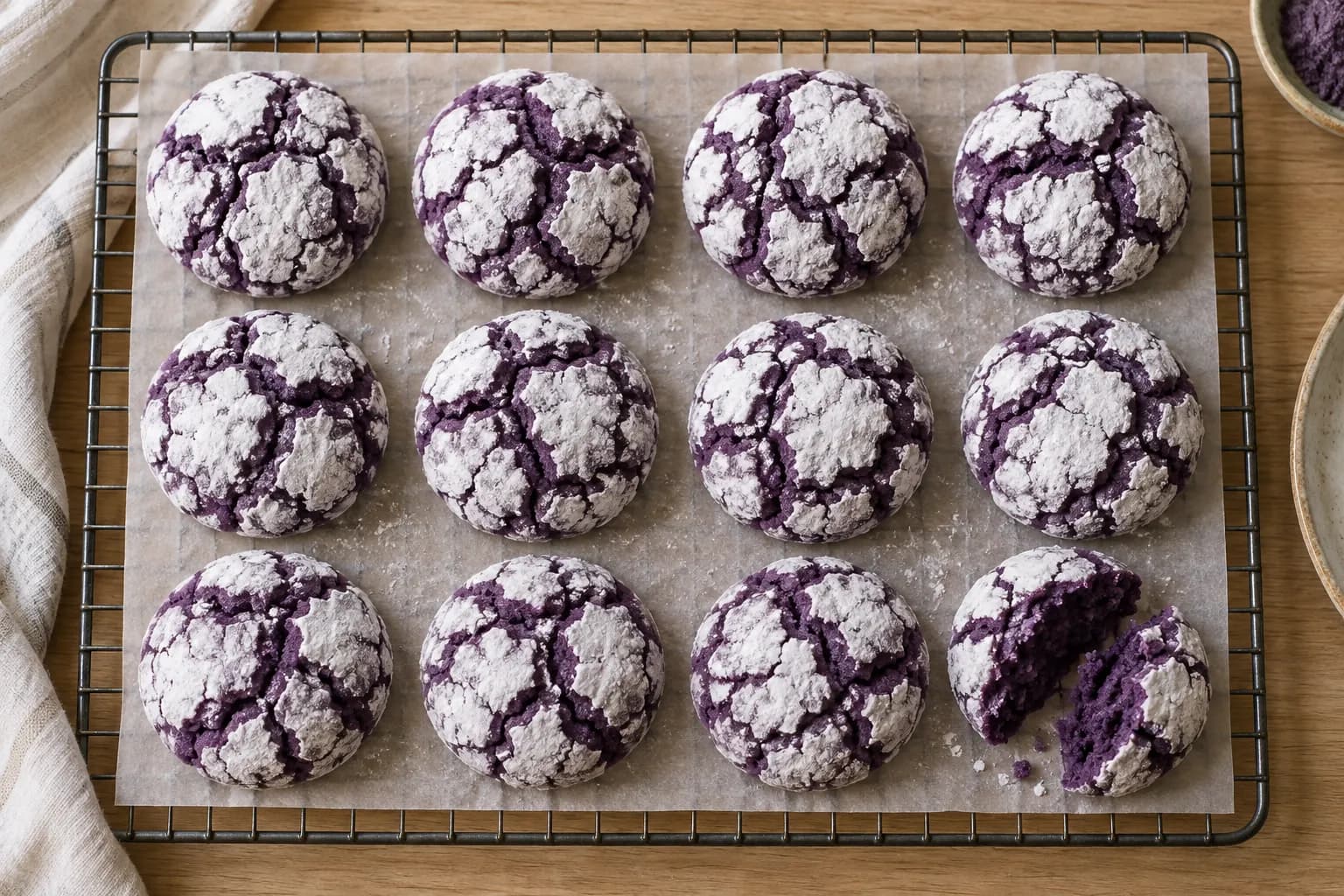
Ube Crinkle Cookies

Rolled in icing sugar and cracking as they bake, crinkles are the most recognisable ube item on social media. The dough needs a rest, so plan production a day ahead.
30 cookies · 30 minutes plus at least 4 hours chilling plus 10-13 minutes baking · about 2 g ube powder per cookie
Ingredients
- 270 g flour
- 1 tsp baking powder
- ¼ tsp salt
- 200 g caster sugar
- 115 g unsalted butter
- 2 eggs
- 57 g ube powder
- 170 ml hot water (for the ube powder)
- ½ tsp vanilla extract
- 120 g icing sugar (for coating)
Method
- Combine the flour, baking powder and salt and set aside.
- Bloom the ube powder in the hot water to a smooth paste and let it cool a little.
- Beat the butter and sugar until pale and fluffy.
- Add the eggs one at a time, then the ube paste and the vanilla.
- Add the dry mix in three additions and stir briefly; the dough will be sticky.
- Cover the dough with cling film and chill at least 4 hours, preferably overnight.
- Heat the oven to 180°C, roll pea-sized balls generously in icing sugar and set them on the tray.
- Bake 10-13 minutes until the tops crack and go matte; do not overbake.
Bakery note: 57 g of powder makes 30 cookies, so 1 kg of ube powder is around 525 pieces. The cookies come out looking slightly underdone but firm up as they cool. They keep 3 days at room temperature, and the raw dough keeps a month in the freezer.
Ube in Turkish desserts: sütlaç, salep, muhallebi and Turkish coffee
Bringing ube into Turkish desserts produces items no one else has on the menu. The main ones are baked rice pudding (sütlaç) coloured with ube powder at 2.5 g per portion, a purple version of the winter cinnamon salep at 2.5 g per portion, a starch-set ube muhallebi at 2 g per portion, and an ube Turkish coffee latte at 6 g per portion, where purple milk foam goes on top of foamy coffee brewed in a cezve. All four are concept builds on classic Turkish recipes; ube's earthy note balances well against plain Turkish coffee. The rule does not change: do not tip ube powder into hot milk, make a paste with cold milk first. In salep, dry-blending the ube powder with the salep powder reduces clumping.
Frequently asked questions
Are ube powder and purple sweet potato powder the same thing?
Botanically, no. Ube is a yam (Dioscorea alata); purple sweet potato is Ipomoea batatas. The two names are often used interchangeably, but the flavour differs: ube is more vanilla-like and creamy. Every gram figure in this article is for ube powder.
What does ube powder taste like?
A soft flavour between vanilla and hazelnut, with a faint earthy note behind it. It sharpens with fat and sugar, and balances well against a bitter base such as plain Turkish coffee.
Why did my ube turn grey or pale purple?
Three common causes: blooming the powder in too much water, overbaking or overbrowning, and pH. Anthocyanins shift towards pink in acid and towards blue-grey in alkali. Do not run the pancake pan too hot, and bloom the powder in roughly 20 ml of liquid per 10 g for a latte.
How many grams of ube powder for one ube latte?
10 g per serving in this recipe, so 1 kg of ube powder is about 100 lattes. A lighter colour and flavour can go down to 6 g; the Turkish coffee latte concept in this article works at 6 g.
Does ube powder hold its colour in the oven?
Yes, though it darkens. The pound cake bakes 65-70 minutes at 175°C and the crinkle cookies 10-13 minutes at 180°C, and both stay purple. The critical point is not to overbake.
Where can I buy ube powder wholesale?
HoReCa packs for cafés, bakeries and chocolate workshops start at 1 kg. Send your target application, estimated monthly usage and packaging requirement through the form on the Ube Powder product page.
Samples and wholesale pricing for cafés and bakeries
Every recipe here is written for pure ube powder, with quantities adapted by our kitchen team. For a sample, a technical specification and wholesale pricing for your menu, share your target application, estimated monthly usage and packaging requirement from the Ube Powder product page. If you want to see how pure powder differs from an instant drink mix before you choose, read our guide to ube powder.
Avalon Global Trade Team
Avalon Global's expert trade team has 10+ years of experience in seafood, coffee, and food product supply chain management across the Turkey-Malaysia trade corridor.